PPSC One Paper MCQs: 100 Most Important Questions for 2026
Preparing for a PPSC One Paper MCQ exam in 2026 requires more than simply memorizing hundreds of questions. Candidates need to understand the important subjects, practice frequently repeated concepts, improve their speed, and regularly test their preparation.
PakTestPro provides a dedicated platform for candidates preparing for PPSC, PMS, CSS and other competitive examinations, with subject-wise MCQs, past papers and mock tests designed for regular practice.
In this guide, we have highlighted 100 important PPSC One Paper MCQs and topics that candidates should revise during their preparation.
Important: PPSC syllabi and examination patterns may vary from one post to another. Always check the official PPSC advertisement and syllabus for the specific post you are applying for.
What Is a PPSC One Paper MCQ Exam?
Many Punjab Public Service Commission (PPSC) recruitment examinations include a written test consisting primarily or entirely of multiple-choice questions (MCQs).
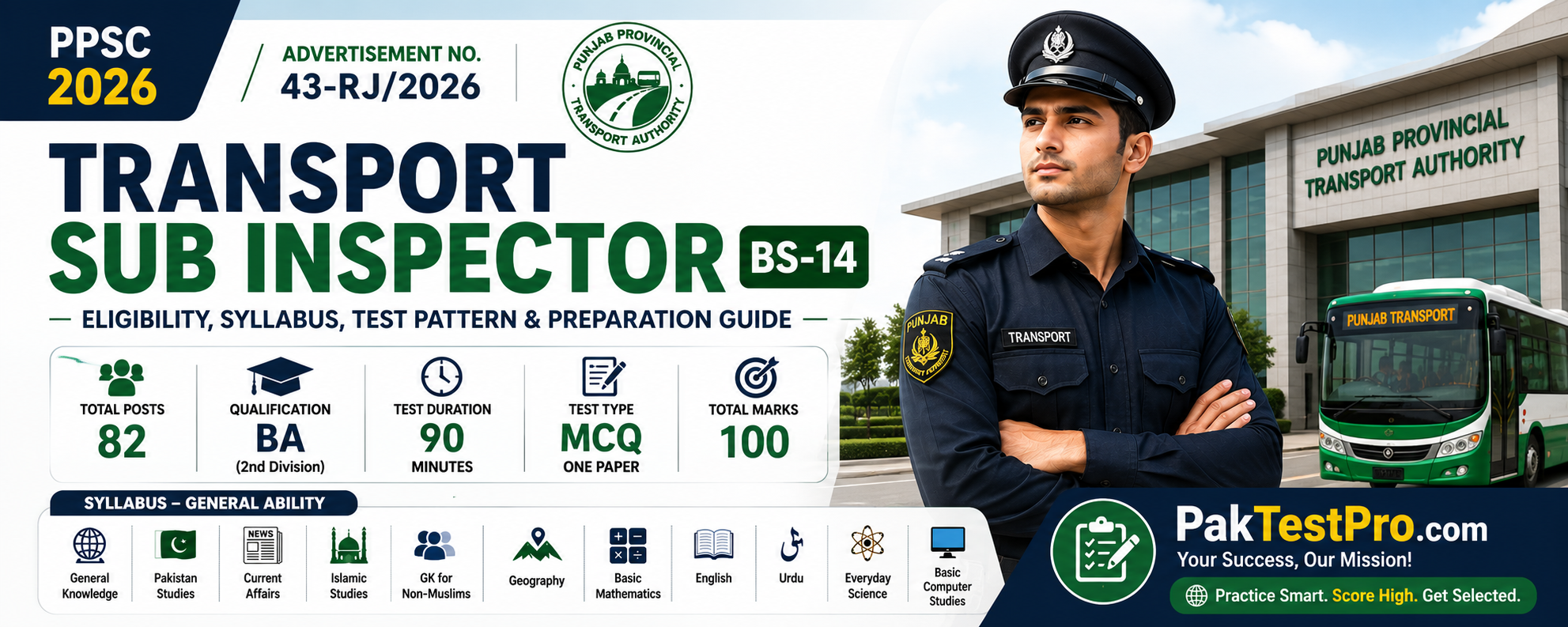
Depending on the post, questions may cover areas such as:
- General Knowledge
- Pakistan Studies
- Current Affairs
- Everyday Science
- English
- Urdu
- Islamic Studies
- Geography
- Mathematics
- Computer Science
- Analytical Reasoning
The exact syllabus depends on the advertised post, so candidates should prepare according to the official syllabus rather than relying on a single generic preparation list.
100 Important PPSC One Paper MCQs for 2026
The following questions cover commonly tested areas and are useful for revision and practice.
Pakistan Studies MCQs
1. What is the capital of Pakistan?
Answer: Islamabad
2. Pakistan came into existence on which date?
Answer: 14 August 1947
3. Who is known as the Founder of Pakistan?
Answer: Quaid-e-Azam Muhammad Ali Jinnah
4. Who was the first Governor-General of Pakistan?
Answer: Muhammad Ali Jinnah
5. Who was the first Prime Minister of Pakistan?
Answer: Liaquat Ali Khan
6. Where was the Lahore Resolution passed?
Answer: Lahore
7. In which year was the Lahore Resolution passed?
Answer: 1940
8. Who presented the Lahore Resolution?
Answer: A. K. Fazlul Huq
9. What is the national language of Pakistan?
Answer: Urdu
10. What is the national flower of Pakistan?
Answer: Jasmine
11. What is the national animal of Pakistan?
Answer: Markhor
12. What is the national bird of Pakistan?
Answer: Chukar
13. Which is the largest province of Pakistan by area?
Answer: Balochistan
14. Which is the largest province of Pakistan by population?
Answer: Punjab
15. Which is the highest mountain in Pakistan?
Answer: K2
16. Where is K2 located?
Answer: Gilgit-Baltistan
17. What is the longest river of Pakistan?
Answer: Indus River
18. Which sea lies to the south of Pakistan?
Answer: Arabian Sea
19. When was the Constitution of Pakistan, 1973, enforced?
Answer: 14 August 1973
20. What is the official name of Pakistan?
Answer: Islamic Republic of Pakistan
General Knowledge MCQs
21. What is the largest continent in the world?
Answer: Asia
22. What is the smallest continent?
Answer: Australia
23. What is the largest ocean in the world?
Answer: Pacific Ocean
24. What is the highest mountain in the world?
Answer: Mount Everest
25. Which country is known as the Land of the Rising Sun?
Answer: Japan
26. What is the capital of Japan?
Answer: Tokyo
27. What is the capital of China?
Answer: Beijing
28. What is the capital of Türkiye?
Answer: Ankara
29. What is the capital of Australia?
Answer: Canberra
30. What is the capital of Canada?
Answer: Ottawa
31. Which is the largest country in the world by area?
Answer: Russia
32. Which is the largest hot desert in the world?
Answer: Sahara Desert
33. Which planet is known as the Red Planet?
Answer: Mars
34. Which planet is the largest in the Solar System?
Answer: Jupiter
35. What is the natural satellite of Earth?
Answer: Moon
36. How many continents are there?
Answer: Seven
37. How many oceans are generally recognized?
Answer: Five
38. What is the currency of Japan?
Answer: Yen
39. What is the currency of the United Kingdom?
Answer: Pound Sterling
40. What is the currency of China?
Answer: Yuan (Renminbi)
Everyday Science MCQs
41. What is the chemical formula of water?
Answer: H₂O
42. What gas is most abundant in Earth's atmosphere?
Answer: Nitrogen
43. Which gas is essential for human respiration?
Answer: Oxygen
44. What is the boiling point of water at standard atmospheric pressure?
Answer: 100°C
45. What is the freezing point of water?
Answer: 0°C
46. Which organ pumps blood throughout the human body?
Answer: Heart
47. Which is the largest organ of the human body?
Answer: Skin
48. Which organ is primarily responsible for filtering blood and producing urine?
Answer: Kidneys
49. What is the basic unit of life?
Answer: Cell
50. Which vitamin is produced in the skin through exposure to sunlight?
Answer: Vitamin D
51. What force attracts objects toward Earth?
Answer: Gravity
52. What is the SI unit of force?
Answer: Newton
53. What is the SI unit of electric current?
Answer: Ampere
54. Which instrument measures temperature?
Answer: Thermometer
55. Which instrument measures atmospheric pressure?
Answer: Barometer
Islamic Studies MCQs
56. What is the first month of the Islamic calendar?
Answer: Muharram
57. What is the last month of the Islamic calendar?
Answer: Dhul-Hijjah
58. How many pillars of Islam are there?
Answer: Five
59. How many obligatory prayers are offered each day?
Answer: Five
60. In which month do Muslims observe fasting?
Answer: Ramadan
61. What is the first revealed word of the Quran?
Answer: Iqra
62. Which is the first Surah of the Quran?
Answer: Surah Al-Fatihah
63. Which is the longest Surah of the Quran?
Answer: Surah Al-Baqarah
64. In which city was the Prophet Muhammad ﷺ born?
Answer: Makkah
65. Where did the first revelation take place?
Answer: Cave Hira
English MCQs
English is an important component of many competitive examinations. Candidates should focus on vocabulary, grammar, sentence correction, synonyms, antonyms and comprehension.
66. Choose the synonym of "Abundant."
Answer: Plentiful
67. Choose the antonym of "Ancient."
Answer: Modern
68. Choose the synonym of "Brief."
Answer: Short
69. Choose the antonym of "Expand."
Answer: Contract
70. What is the plural of "Criterion"?
Answer: Criteria
71. What is the plural of "Phenomenon"?
Answer: Phenomena
72. What is the past tense of "Go"?
Answer: Went
73. What is the past participle of "Write"?
Answer: Written
74. Identify the adjective in: "She is an intelligent student."
Answer: Intelligent
75. Identify the adverb in: "He runs quickly."
Answer: Quickly
Computer Science MCQs
Computer-related questions are frequently useful for general competitive examination preparation.
76. What does CPU stand for?
Answer: Central Processing Unit
77. What does RAM stand for?
Answer: Random Access Memory
78. What does ROM stand for?
Answer: Read-Only Memory
79. Which device is commonly used to enter text into a computer?
Answer: Keyboard
80. Which device displays information visually?
Answer: Monitor
81. What does WWW stand for?
Answer: World Wide Web
82. What does HTTP stand for?
Answer: Hypertext Transfer Protocol
83. What is Microsoft Word primarily used for?
Answer: Word processing
84. What is Microsoft Excel primarily used for?
Answer: Spreadsheets and data analysis
85. What is Microsoft PowerPoint primarily used for?
Answer: Creating presentations
Geography MCQs
86. Which imaginary line divides Earth into the Northern and Southern Hemispheres?
Answer: Equator
87. Which imaginary line is located at 0° longitude?
Answer: Prime Meridian
88. Which is the largest island in the world?
Answer: Greenland
89. Which river is commonly regarded as the longest river in South America?
Answer: Amazon River
90. Which mountain range separates much of Europe from Asia?
Answer: Ural Mountains
Mathematics & Analytical Reasoning MCQs
91. What is 15% of 200?
Answer: 30
92. What is the square of 12?
Answer: 144
93. What is the square root of 144?
Answer: 12
94. If 5 × 8 = ?
Answer: 40
95. What is the average of 10, 20 and 30?
Answer: 20
96. If a number is divided by 5 and the result is 10, what is the number?
Answer: 50
97. What comes next: 2, 4, 8, 16, ___?
Answer: 32
98. If A is taller than B and B is taller than C, who is the shortest?
Answer: C
99. A clock shows 3:00. What is the angle between the hour and minute hands?
Answer: 90°
100. If 3 books cost Rs. 600, what is the cost of one book?
Answer: Rs. 200
How to Prepare for PPSC One Paper Exams
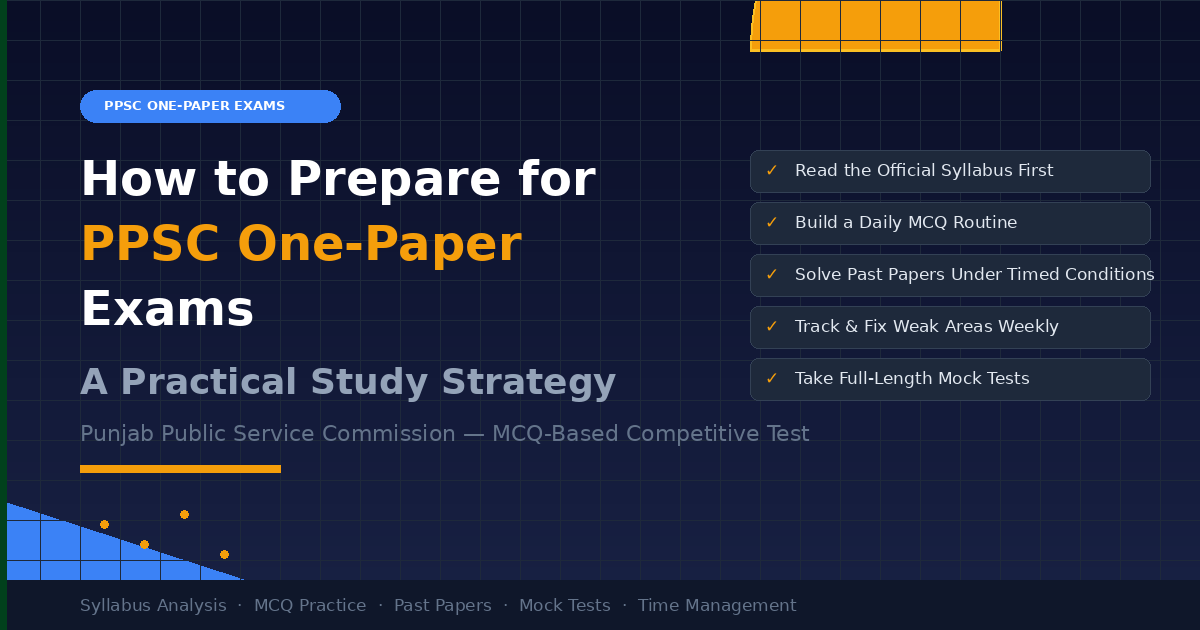
Simply reading MCQs is not enough. Effective preparation requires revision + practice + testing.
1. Study Subject-Wise
Divide your preparation into major subjects such as:
- Pakistan Studies
- General Knowledge
- Current Affairs
- Everyday Science
- English
- Islamic Studies
- Computer
- Geography
- Mathematics
- Analytical Reasoning
Studying one subject at a time makes it easier to identify weak areas.
2. Practice Previous PPSC Papers
Past papers help candidates understand the style and level of questions asked in competitive examinations.
Instead of only memorizing answers, try to understand why the answer is correct.
3. Attempt Mock Tests
Mock tests are useful for measuring preparation under time pressure.
On PakTestPro, candidates can practice MCQs and use mock-test style preparation to improve their speed and accuracy.
4. Revise Current Affairs Regularly
Current Affairs can change quickly. Candidates preparing for a 2026 examination should revise recent national and international developments and verify time-sensitive information from reliable sources.
5. Improve Your English
For many competitive examinations, English preparation should include:
- Synonyms
- Antonyms
- Prepositions
- Sentence correction
- Vocabulary
- Grammar
- Active and passive voice
- Direct and indirect speech
- Idioms and phrases
6. Practice With a Timer
Knowing the answer is only one part of an MCQ examination. You also need to answer questions within the available time.
Try solving practice sets under timed conditions.
Prepare for PPSC Exams With PakTestPro
PakTestPro is an online MCQ preparation platform for candidates preparing for PPSC, PMS, CSS and other competitive examinations.
You can use PakTestPro to:
- Practice subject-wise MCQs
- Revise important concepts
- Attempt previous papers
- Take mock tests
- Review incorrect answers
- Improve your examination speed
- Practice regularly from your mobile or computer
Instead of reading hundreds of questions randomly, create a daily preparation routine and track the subjects where you need more practice.
Frequently Asked Questions
Is this list enough to pass a PPSC One Paper exam?
No single list of 100 MCQs can guarantee success. The actual preparation should be based on the official syllabus for your specific PPSC post, followed by extensive MCQ practice and revision.
Which subjects should I prepare first?
Start with the subjects included in your official syllabus. Pakistan Studies, General Knowledge, Current Affairs, English, Everyday Science, Islamic Studies, Computer and Mathematics are commonly useful areas, but the actual weightage depends on the post.
Are PPSC One Paper questions repeated?
Concepts and topics may recur in competitive examinations, but candidates should not rely on memorizing previous questions. Prepare the underlying concepts and practice questions from multiple sources.
How can I improve my PPSC MCQ score?
Regular timed practice, revision of mistakes, subject-wise preparation and mock tests can help improve preparation.
Where can I practice PPSC MCQs online?
Candidates can use PakTestPro for online MCQ practice, subject preparation, past-paper practice and mock tests.
Final Preparation Tip
Your PPSC preparation should not depend on one "100 important questions" list. Use such lists for quick revision, but build your preparation around the official syllabus, previous papers, current affairs, subject-wise MCQs and regular mock tests.
Prepare smarter. Practice better. Succeed with PakTestPro!
Disclaimer: PakTestPro is an independent educational and test-preparation platform. It is not affiliated with, sponsored by, or endorsed by the Punjab Public Service Commission (PPSC) or any other government department. For official advertisements, eligibility criteria, syllabi, schedules and application information, candidates should always consult the relevant official government source.