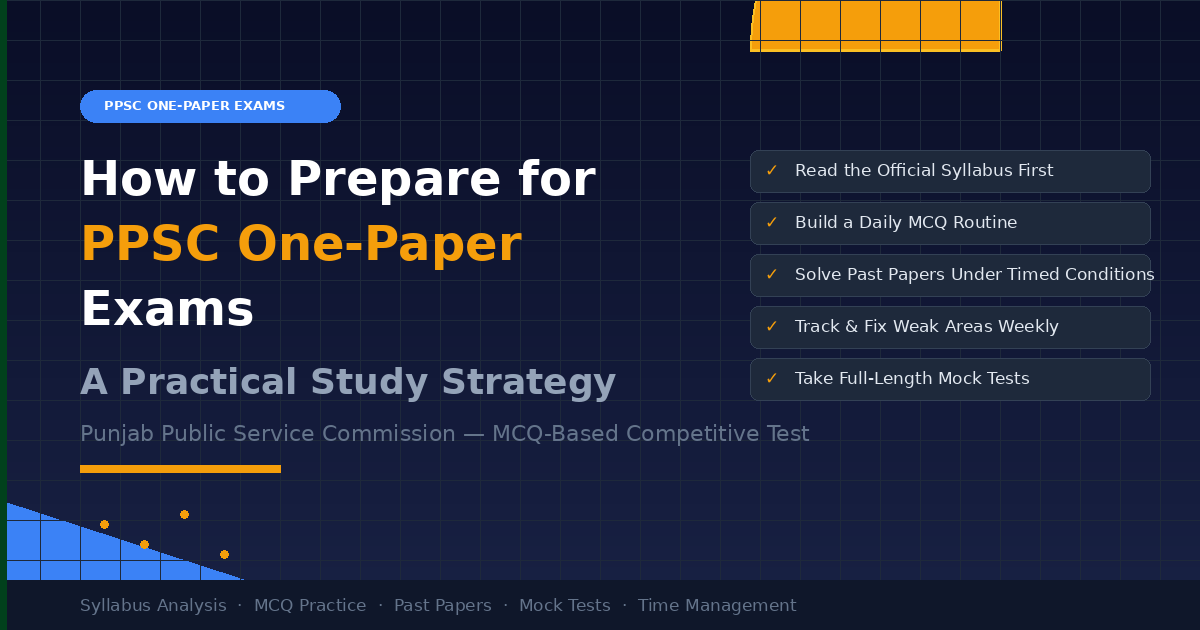
How to Prepare for PPSC One-Paper Exams: A Practical Study Strategy
PPSC one-paper exams are among the most competitive recruitment tests in Punjab. Candidates often have to prepare multiple subjects and answer a large number of MCQs within a limited amount of time.
For many candidates, the biggest challenge isn't finding study material. It is deciding what to study, how to prioritize topics, how much to practice, and how to manage time during the test.
A focused preparation strategy can make the process much easier.
This guide explains a practical step-by-step strategy for preparing for PPSC one-paper exams, including syllabus analysis, daily study planning, MCQ practice, past papers, mock tests, revision, and time management.
Important: PPSC syllabi, paper patterns, marking schemes, and requirements can vary by post. Always check the latest official PPSC advertisement and syllabus for the specific position you are applying for.
What Is a PPSC One-Paper Exam?
A PPSC one-paper examination generally refers to a written objective test in which candidates answer multiple-choice questions covering several subjects or areas.
Depending on the post, the paper may include areas such as:
- General Knowledge
- Pakistan Studies
- Current Affairs
- Everyday Science
- English
- Urdu
- Islamic Studies
- Computer Science
- Mathematics
- Geography
- Relevant subject knowledge
The exact combination depends on the advertised post.
This means that preparation should begin with the official syllabus, rather than a generic list of subjects.
Step 1: Understand the Syllabus
Before studying, find out exactly what your examination requires.
Read the latest PPSC advertisement and syllabus and identify:
- Subjects
- Topics
- Number of questions
- Test duration
- Relevant subject portion
- Any specified marking scheme
- Negative marking, if applicable
Once you have this information, create a subject checklist.
For example:
| SubjectStatus | |
| General Knowledge | Not Started |
| Pakistan Studies | In Progress |
| Current Affairs | In Progress |
| English | Not Started |
| Everyday Science | Completed |
| Computer | In Progress |
This simple system makes it easier to monitor your progress.
You can use PakTestPro's subject-wise MCQs to practice individual subjects after covering their relevant topics.
Step 2: Divide the Syllabus Into Topics
Don't look at the syllabus as one huge list.
Break it down:
Subject → Topic → Subtopic → MCQ Practice → Revision
For example:
Pakistan Studies
- Pakistan Movement
- Important personalities
- Constitutional development
- Geography
- Political history
- National institutions
- Important events
Everyday Science
- Human body
- Physics
- Chemistry
- Biology
- Environment
- Space
- Scientific discoveries
Computer
- Hardware
- Software
- Operating systems
- MS Office
- Internet
- Networking
- Computer history
- Shortcuts
Breaking subjects into smaller units makes your daily targets much easier to achieve.
Step 3: Create a Daily Study Plan
A good timetable should be realistic.
For example, if you have five hours available:
| ActivityTime | |
| Main Subject | 90 minutes |
| Second Subject | 60 minutes |
| English | 45 minutes |
| Current Affairs/GK | 45 minutes |
| MCQ Practice | 45 minutes |
| Revision | 15 minutes |
You don't have to follow this exact schedule.
If you have only two or three hours available, create a smaller version.
The important thing is consistency.
Three focused hours every day are better than ten hours once a week.
Step 4: Focus on High-Value Topics
Not every topic deserves exactly the same amount of preparation time.
Give priority to:
- Topics mentioned in the official syllabus
- Frequently tested areas
- Important concepts
- Topics appearing in past papers
- Your weak areas
For example, if you are consistently scoring 85% in General Knowledge but only 55% in English, additional English practice may improve your overall score more effectively.
Use your practice results to decide where to spend your time.
Step 5: Study the Basics Before Solving Thousands of MCQs
One common mistake is solving thousands of random MCQs without understanding the underlying concepts.
MCQs are most useful when combined with proper study.
Use this method:
Study → Practice → Check → Analyze → Revise
For example:
- Study the topic "Constitutional Development of Pakistan."
- Solve 20–30 relevant MCQs.
- Check your answers.
- Review every incorrect answer.
- Revise the relevant concept.
- Take another short test later.
This approach is more effective than simply trying to memorize answer keys.
Step 6: Practice MCQs Every Day
Because the PPSC one-paper examination is objective, regular MCQ practice is essential.
Set a daily target.
For example:
Week 1: 50 MCQs per day
Week 2: 75 MCQs per day
Week 3: 100 MCQs per day
You don't have to follow these exact numbers.
Quality matters more than quantity.
When reviewing questions, pay particular attention to:
- Questions you answered incorrectly
- Questions you guessed
- Similar-looking options
- Repeated concepts
- Questions that took too long
PakTestPro's subject-wise MCQ practice can help you practice topics individually rather than taking random questions all the time.
Step 7: Use Past Papers Intelligently
Past papers are extremely useful for one-paper preparation.
They can help you understand:
- Question style
- Difficulty level
- Frequently tested topics
- Important facts
- Subject distribution
- Time requirements
Don't just memorize the answers.
Analyze the questions.
If you encounter several questions related to a particular topic, study that topic in greater depth.
For example:
Question: Which constitutional amendment introduced a particular change?
Don't stop after memorizing the answer.
Review:
- The amendment
- Its background
- Related constitutional provisions
- Other important amendments
- Similar questions
This makes your knowledge more flexible.
You can explore PakTestPro's exam preparation resources for additional practice.
Step 8: Prepare Current Affairs Regularly
Current Affairs can be difficult because the information changes continuously.
Don't try to memorize every headline.
Focus on important areas such as:
- Pakistan's economy
- International relations
- Major national developments
- International organizations
- Regional affairs
- Science and technology
- Climate and environment
- Major international events
- Important agreements and developments
Create short notes.
For example:
Issue → Date → Important facts → Key people/organizations → Pakistan's relevance
Review your notes regularly.
You can use Current Affairs MCQs on PakTestPro for additional objective-question practice.
Always verify changing information from reliable and authoritative sources.
Step 9: Give Special Attention to English
English is often an important part of competitive recruitment examinations.
Depending on the post, you may encounter:
- Synonyms
- Antonyms
- Vocabulary
- Grammar
- Prepositions
- Idioms
- Sentence correction
- One-word substitutions
- Sentence completion
Spend some time on English every day.
Even 20–30 minutes of regular practice can make a difference over time.
Create a vocabulary list and revise it repeatedly.
You can practice with English MCQs on PakTestPro.
Step 10: Strengthen Pakistan Studies
Pakistan Studies is an important area in many competitive examinations.
Focus on:
- Pakistan Movement
- Important personalities
- Constitutional history
- Political developments
- Geography
- National institutions
- Important historical events
- Important dates and agreements
- Contemporary national issues
Don't simply memorize isolated dates.
Try to understand the sequence of events.
A simple timeline can help:
Event → Date → Important people → Cause → Result
Use Pakistan Studies MCQs on PakTestPro to reinforce your preparation.
Step 11: Don't Ignore Everyday Science and Computer
Candidates sometimes focus heavily on General Knowledge and Pakistan Studies while neglecting Everyday Science and Computer.
These subjects can provide valuable scoring opportunities.
For Everyday Science, review:
- Human body
- Basic biology
- Chemistry
- Physics
- Environment
- Earth science
- Space
- Scientific instruments
- Important discoveries
For Computer, focus on:
- Hardware
- Software
- Operating systems
- MS Word
- MS Excel
- PowerPoint
- Internet
- Networking
- Cybersecurity basics
- Computer terminology
- Keyboard shortcuts
The exact topics should match the syllabus for your post.
Step 12: Maintain a Mistake Notebook
Don't allow incorrect answers to disappear after you finish a test.
Record them.
Your notebook can contain:
| SubjectTopicMistake | ||
| English | Prepositions | Confused usage |
| Pakistan Studies | History | Incorrect date |
| Computer | Networking | Confused terminology |
| Science | Biology | Incorrect concept |
Review this notebook every few days.
Before the examination, it can become one of your most useful revision resources.
Step 13: Take Timed Mock Tests
Knowing the material is only part of the challenge.
You also need to answer questions quickly and accurately.
Take regular timed tests.
During a mock test:
- Set the appropriate time limit.
- Remove distractions.
- Don't use notes.
- Attempt the complete paper.
- Record your score.
- Review incorrect answers.
- Analyze your time management.
Track your progress.
For example:
| TestScore | |
| Mock Test 1 | 62% |
| Mock Test 2 | 67% |
| Mock Test 3 | 72% |
| Mock Test 4 | 76% |
The objective isn't just to complete tests.
The objective is to improve your performance.
Step 14: Develop a Smart Exam-Hall Strategy
Time management can make a major difference in a one-paper examination.
A useful approach is to divide questions into three categories:
Category 1 — Easy
Answer immediately.
Category 2 — Moderate
Think carefully but don't spend too much time.
Category 3 — Difficult
Mark for review and return later if time permits.
Avoid spending several minutes on a single difficult question while easier questions remain unanswered.
Read every question carefully.
Many mistakes occur because candidates rush through questions they actually know.
If negative marking applies to your examination, follow the official instructions and use guessing cautiously.
Step 15: Revise More as the Exam Gets Closer
Your preparation strategy should change as the examination approaches.
Early Stage
Focus on learning.
Middle Stage
Focus on learning + practice.
Final Stage
Focus on revision + testing.
During the final weeks, don't spend most of your time starting completely new books.
Review:
- Short notes
- Mistake notebook
- Important facts
- Vocabulary
- Past papers
- Weak topics
- Mock-test mistakes
A 30-Day PPSC One-Paper Study Plan
If you have approximately one month, you can organize your preparation like this.
Days 1–7: Foundation
Focus on:
- Understanding the syllabus
- Pakistan Studies
- General Knowledge
- English basics
- Current Affairs
Days 8–15: Subject Preparation
Focus on:
- Everyday Science
- Computer
- Geography
- Islamic Studies
- Relevant subject
- Additional syllabus areas
Days 16–22: Intensive MCQ Practice
Focus on:
- Topic-wise MCQs
- Past papers
- Weak subjects
- Mistake analysis
Days 23–27: Mock Tests
Take full-length timed tests.
Analyze every test carefully.
Days 28–30: Final Revision
Review:
- Mistake notebook
- Important facts
- Current Affairs
- Difficult vocabulary
- Weak topics
- Frequently repeated concepts
Avoid overloading yourself with new material during the final days.
Common PPSC One-Paper Preparation Mistakes
1. Studying Without the Syllabus
This can lead to wasted preparation time.
2. Solving Random MCQs All Day
MCQ practice should be combined with proper study and revision.
3. Ignoring Past Papers
Past papers can reveal important question patterns.
4. Not Tracking Mistakes
If you don't analyze mistakes, you may repeat them.
5. Ignoring Current Affairs
Current Affairs requires continuous preparation.
6. Neglecting English
English can significantly affect your overall score.
7. Studying Too Many Books
Too many resources can create confusion.
8. Taking Tests Without Time Limits
Practice under realistic examination conditions.
9. Spending Too Much Time on Easy Topics
Focus more attention on areas where you need improvement.
10. Leaving Revision Until the Last Day
Revision should happen throughout your preparation.
Frequently Asked Questions
How long does it take to prepare for a PPSC one-paper exam?
It depends on your existing knowledge, the post, syllabus, and available study time. Some candidates may prepare in a few weeks, while others may need several months.
How many MCQs should I practice daily?
There is no fixed number. Start with a manageable target and increase it gradually. More importantly, review your incorrect answers rather than simply counting questions.
Are PPSC past papers important?
Yes. They help you understand question styles, identify important topics, and evaluate your preparation.
How should I prepare Current Affairs?
Follow major national and international developments regularly. Make concise notes and practice relevant questions.
Should I memorize MCQs?
Memorization can help with factual information, but understanding the underlying topic is safer because examiners can ask the same concept in a different way.
How can I improve my PPSC score quickly?
Identify your weakest subjects, practice targeted MCQs, analyze mistakes, revise frequently, and take timed mock tests.
Final Checklist Before Your PPSC One-Paper Exam
Before entering the examination hall, make sure you have:
- Read the latest syllabus
- Covered all major subjects
- Practiced topic-wise MCQs
- Solved relevant past papers
- Taken timed mock tests
- Reviewed your mistakes
- Revised Current Affairs
- Practiced English
- Reviewed important facts
- Identified your weakest topics
- Prepared a time-management strategy
Conclusion
Preparing for a PPSC one-paper exam becomes much easier when you have a clear system.
Start with the official syllabus, divide it into manageable topics, create a realistic daily schedule, study the fundamentals, and practice MCQs consistently.
Use past papers to understand question trends and mock tests to improve your speed and accuracy.
Most importantly, don't simply count the number of questions you solve.
Study the topic, practice the questions, analyze your mistakes, and revise what you learned.
A simple preparation cycle can make a major difference:
Learn → Practice → Analyze → Revise → Test
Use PakTestPro's subject-wise MCQs for focused practice and explore PakTestPro's exam resources to support your overall preparation.
With a disciplined study plan, regular practice, and smart revision, you can make your PPSC one-paper preparation more focused, efficient, and exam-oriented.